
Introduction
A customer receives a sale announcement but cannot see the product. A prospective student wants course details before requesting counselling. A property buyer needs a brochure and a clear way to arrange a visit.
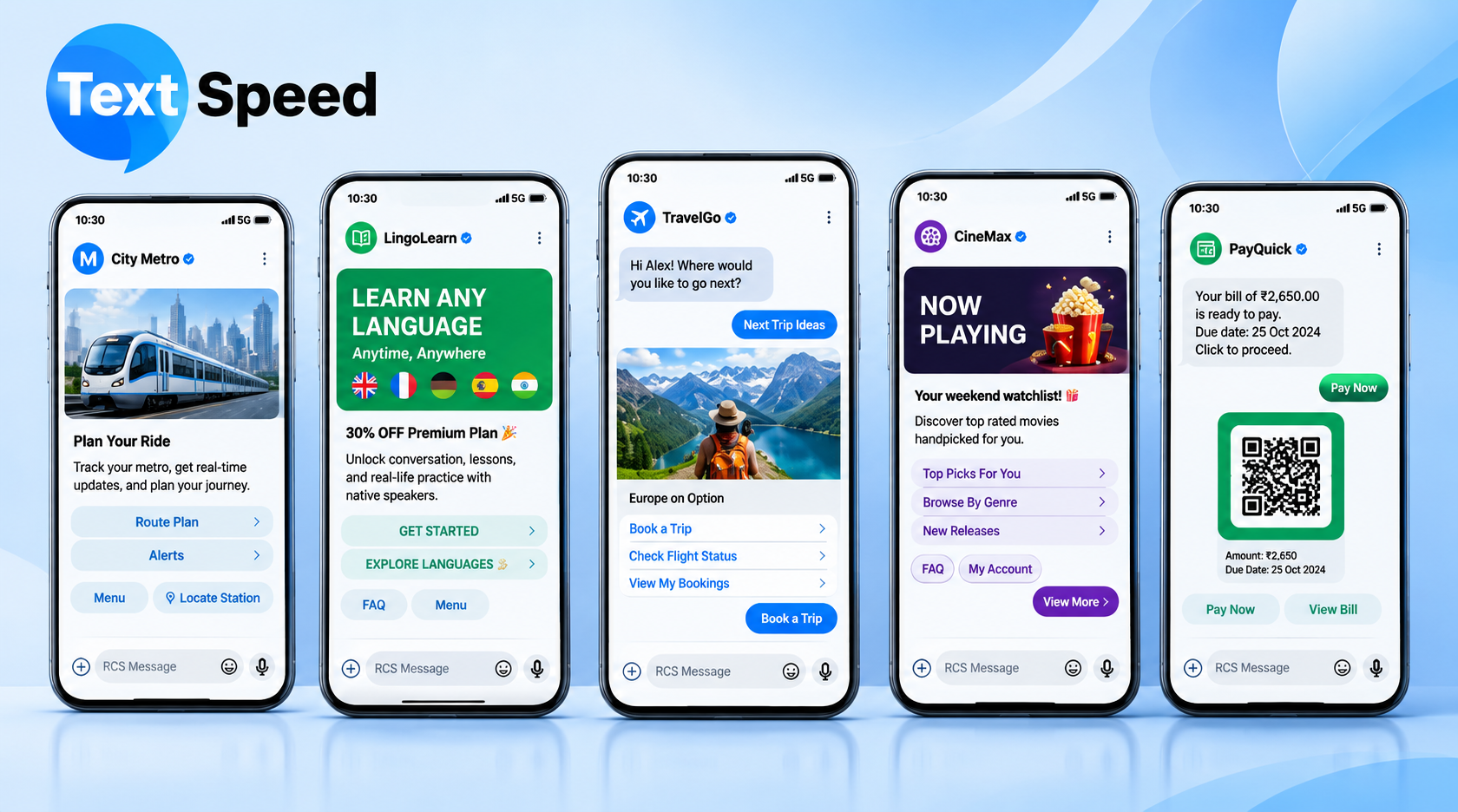
A plain text message can introduce these opportunities, but some conversations need more context. An RCS message can combine useful information, visuals and response options inside a supported messaging application.
For Delhi businesses, choosing a provider means looking beyond an attractive campaign preview. You need to understand audience coverage, sender approval, response handling and what happens when RCS is unavailable.
This guide explains those decisions, shows practical industry applications and outlines how to evaluate Textspeed for your business. The best fit depends on your requirements, rather than a universal provider ranking.
What Is an RCS Message?
An RCS message uses Rich Communication Services to support messaging beyond plain text. For business communication, RCS can combine a branded sender identity with media, rich cards and suggested actions. Available features depend on the recipient’s capabilities, service availability and the business messaging configuration.
For example, a course invitation could show programme information and offer “View Course” or “Request Counselling” options. The booking or enquiry process still needs a connected system or employee.
How Does RCS Business Messaging Work?
1. Define the audience and purpose
Start with a specific task: generate appointment requests, introduce relevant products or communicate an order update.
Use reliable customer records to identify eligible recipients. A mobile number alone does not establish that someone lives in Delhi or wants messages about your service.
2. Prepare the business sender
Your provider helps prepare the RCS agent—the business identity used for messaging—and the applicable verification and launch process. Supply accurate branding, contact details and a clear description of the intended communication.
3. Check recipient capabilities
Capability checks help determine whether recipients can communicate with the RCS agent and which features are supported. This is important when estimating campaign reach and designing interactions.
4. Build and test the message
Prepare the content, visuals and intended action. Check how the message appears on representative devices, whether important text remains visible and whether every link works.
5. Connect responses and alternatives
Assign responsibility for replies. If customers request callbacks, define who receives the request and how completion is recorded.
Where configured, SMS fallback provides an alternative for recipients who cannot receive the intended RCS experience. It requires its own suitable content and sending arrangements.
Discuss an RCS pilot with Textspeed using one audience, one message and one measurable customer action.
Which Features Should You Look for in an RCS Provider?
1. Accurate business branding
Customers should recognise who is contacting them. Review the displayed name, logo, profile information and destination domains. Consistent branding helps recipients understand the message’s source.
2. Rich cards with readable content
Rich cards combine media and supporting information. Keep the essential details in text rather than placing everything inside an image. Check cropping and readability before launch.
3. Carousels for relevant choices
A carousel can present several products, courses or properties. Select options that match the audience’s interests; showing too many unrelated choices makes the next step harder.
4. Suggested replies and actions
Response options should match the task. “Request Callback” needs a callback workflow, while “View Details” should open the relevant page. Supported actions and rendering should be tested for the intended audience.
5. Integration and response ownership
Ask how replies connect with your CRM, helpdesk or booking system. Confirm which actions are included and which require development.
6. Reporting and fallback controls
Request a demonstration of delivery reports, available engagement data and fallback activity. Understand the difference between a message event and a completed business outcome, such as a confirmed appointment.
What Benefits Can RCS Offer Delhi Businesses?
A well-designed RCS campaign can support practical improvements:
- More context in one message: Recipients can review relevant information before deciding what to do.
- Clearer next steps: Focused actions reduce uncertainty about how to enquire or respond.
- Recognisable communication: Consistent branding helps identify the sender.
- Less repetitive information sharing: Common opening questions can be addressed in the message.
- Better enquiry routing: Structured responses can help direct requests to the appropriate team.
- More useful campaign evaluation: Messaging activity can be reviewed alongside bookings, purchases or resolved requests.
These benefits depend on audience relevance, implementation and follow-up. A visually polished RCS message cannot compensate for inaccurate information or an enquiry that nobody answers.
How Can Different Industries Use RCS Messages?
The following examples illustrate possible workflows rather than claimed customer results.
How can retail and e-commerce businesses present products?
Customer engagement for retail and e-commerce businesses can include relevant product launches, collections or order-related communication.
A Delhi retailer might present selected products with links to matching pages. Check stock, prices and offer conditions before sending. If the campaign supports several branches, make branch eligibility clear.
How can property businesses generate site-visit enquiries?
Buyer communication for real estate businesses can combine property visuals, location information and an enquiry action.
Segment prospects using recorded requirements such as property type and preferred locality. A visit request should reach a salesperson who knows the project, while confirmation should follow only after a slot is agreed.
How can educational institutions organise counselling requests?
Admissions communication for educational institutions can introduce courses and help applicants request counselling.
For a Delhi institute, English or Hindi content can reflect the audience’s recorded preference. Route requests by programme or campus and stop unnecessary booking reminders after an appointment is confirmed.
How can healthcare providers coordinate appointments?
Appointment communication for healthcare providers can include booking details, clinic directions and links to an appropriate rescheduling process.
Keep messages limited to necessary information. Direct sensitive records to authenticated systems rather than displaying private health details in notifications.
How can logistics businesses handle delivery queries?
Customer messaging for logistics businesses can provide shipment context, tracking access and assistance options.
Connect replies with the correct shipment reference. A customer selecting “Request Assistance” should reach an operational queue, rather than receive another generic tracking message.
How can financial services businesses support enquiries?
Customer communication for banking and financial services can support appropriate service information and requested appointments.
Review the specific use case against platform policies and applicable requirements. Direct sensitive account actions to authenticated channels and avoid requesting confidential credentials through chat.
What Challenges Should Businesses Prepare For?
|
Challenge |
Practical response |
|
Only part of the audience is RCS-reachable |
Estimate coverage before committing campaign volumes. |
|
Images or text display poorly |
Test representative devices and simplify the layout. |
|
Customers click but do not complete the action |
Review the destination page, form and follow-up process. |
|
Replies remain unattended |
Assign staff, operating hours and escalation rules. |
|
RCS and SMS create duplicate communication |
Agree on fallback triggers and duplicate controls. |
|
Customers receive unwanted messages |
Maintain permission records and honour opt-outs promptly. |
Google’s RCS acceptable-use policy requires accurate business information, clear disclosure of purpose and appropriate consent before soliciting users. An easy opt-out mechanism is also required. A purchased contact list should not be treated as evidence of permission.
How Do You Choose the Best RCS Message Provider in Delhi?
The strongest comparison is a practical demonstration of your workflow.
Ask each provider to show how a customer receives the message, requests help, reaches the correct employee and gets a recorded outcome.
|
Evaluation area |
What to ask |
|
Coverage |
How will you estimate reachability for our contacts? |
|
Onboarding |
Which verification and launch steps will you support? |
|
Campaign design |
Who prepares and tests cards, media and actions? |
|
Integration |
What connects with our existing systems? |
|
Response handling |
Where do replies go, and who owns unresolved requests? |
|
Fallback |
When is SMS attempted, and what charges apply? |
|
Support |
Who investigates sending or workflow problems? |
For Delhi-focused campaigns, confirm the service area, branch, language and response hours. Keep Noida, Gurugram and other NCR locations separate where the offer or operational coverage differs.
Request an itemised quotation covering setup, messaging usage, integrations, support and fallback. Compare equivalent scopes rather than headline rates.
Why Consider Textspeed for RCS Messaging?
Textspeed’s RCS messaging service describes branded messaging, rich media, carousels, response options and campaign reporting. These capabilities can support product discovery, enquiries and customer updates when configured around a working business process.
Its RCS fallback service provides an option to combine RCS with SMS. Discuss the fallback trigger, message classification, content and reporting before launch. Alternative channels can improve coverage opportunities, but delivery should not be assumed to be guaranteed.
For your evaluation, give Textspeed a specific brief: your Delhi audience, campaign purpose, language preference, existing software and expected response.
Request a Textspeed RCS demo and tailored quotation to review the complete customer journey before expanding the campaign.
FAQ
Which is the best RCS message service provider in Delhi?
There is no single best provider for every business. Compare audience coverage, onboarding support, integrations, response handling and full commercial terms. Textspeed is an option to evaluate through a demonstration and pilot based on your actual customer communication requirements.
Can an RCS message reach every smartphone?
No. RCS business messaging availability depends on recipient capabilities and service support. Run capability checks and plan an appropriate alternative where necessary. Do not assume that owning a smartphone means a recipient can receive every business RCS feature.
Do customers need a separate business application?
Customers do not need your company’s own application to receive messages in a supported RCS messaging client. However, actions such as purchases, private account access or appointment bookings may open a website, portal or another connected service.
Can businesses send RCS messages in Hindi and English?
Businesses can prepare content in languages relevant to their audience. Confirm support and rendering with the provider, then test the final copy on representative devices. Use recorded language preferences where available and have a fluent reviewer check translations before launch.
How much does an RCS campaign cost?
Request pricing based on message types, expected traffic, setup, integrations and optional fallback. Ask how usage is measured and which additional fees apply. Evaluate the cost of the complete workflow, including handling enquiries, rather than considering only the initial message charge.
Is RCS better than SMS for business communication?
RCS offers richer presentation and interaction on supported devices. SMS remains useful for straightforward text communication and alternative coverage. Choose according to the audience, urgency and task; a combined approach may suit some workflows better than relying on either channel alone.
Written by SEO Specialist, Textspeed
Telecom & CPaaS Technical Specialists · Reviewed for AccuracyOur content is authored by enterprise communications specialists and strictly reviewed for technical accuracy, regulatory compliance (TRAI/DLT), and industry best practices. Read our Editorial Policy to learn how we maintain trust.