
Introduction
A parcel reaches the local hub, but the customer still sees yesterday’s update. A driver attempts delivery while the recipient is away. The customer replies to a notification, yet nobody in operations sees the message.
These gaps create avoidable calls and follow-ups. Sending more notifications helps only when the information is accurate and the customer’s response reaches someone who can act.
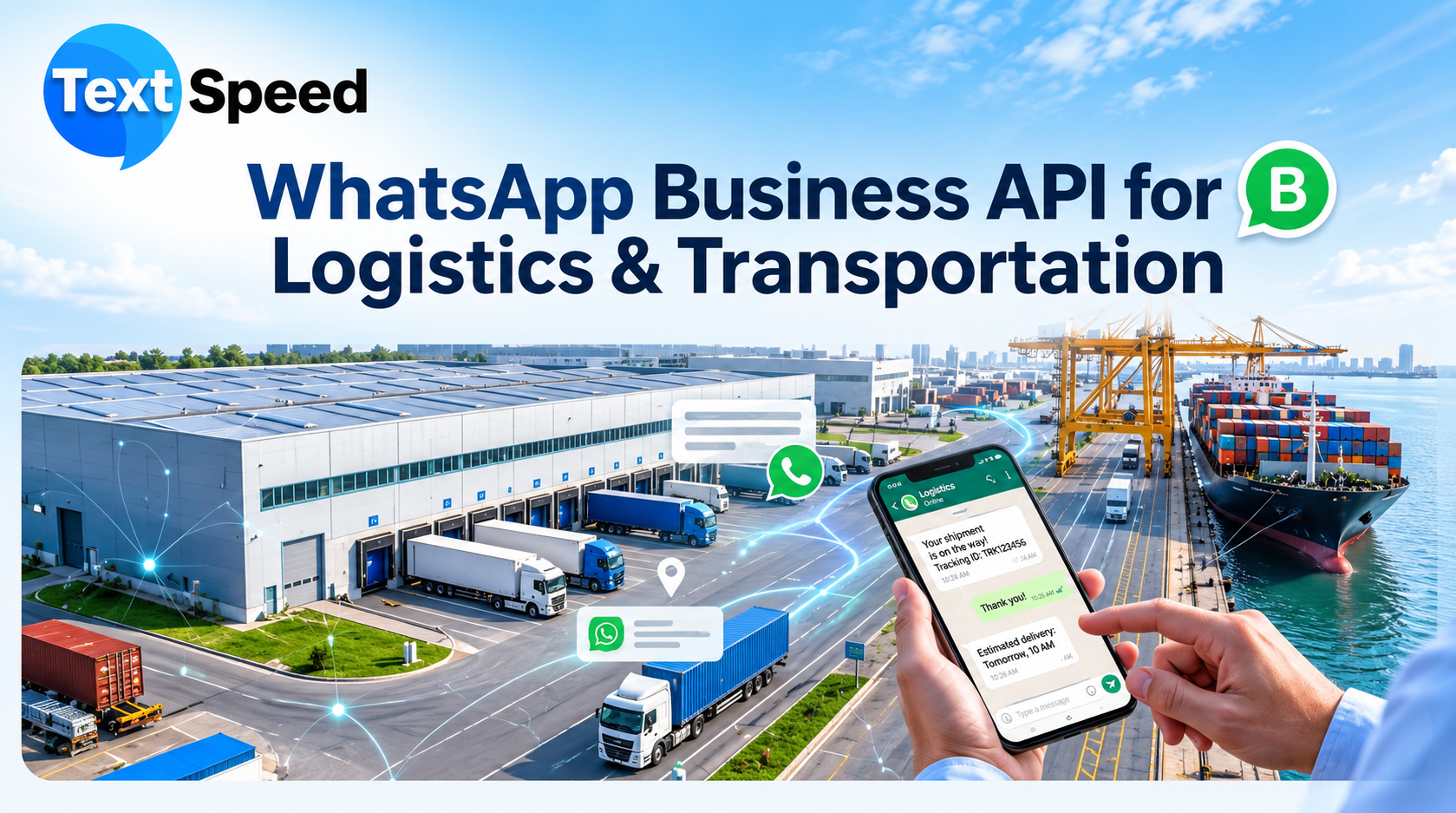
WhatsApp Business API for logistics connects customer messaging with shipment events and support workflows. A dispatch update can include a tracking link. A delivery exception can invite a response. A support employee can review the conversation alongside the shipment reference.
This guide explains how logistics and transportation businesses can build those workflows, which features matter and what to check before choosing Textspeed for implementation.
What Is WhatsApp Business API for Logistics?
WhatsApp Business API for logistics is the use of Meta’s WhatsApp Business Platform to connect shipment-related communication with business software. Logistics companies can send notifications, receive customer replies and support automated conversations. Shipment tracking, rescheduling and operational updates depend on integrations with the systems managing those activities.
The API carries messages. Your transport management system, carrier platform or order system remains responsible for the shipment information behind them.
How Does WhatsApp Business API Work for Logistics?
A dependable workflow connects an operational event to a relevant message and a defined response.
1. Capture the recipient’s communication permission
Explain during booking or checkout that the customer can receive shipment updates through WhatsApp. Record the relevant permission and honour requests to stop messages. Having a delivery phone number alone does not establish permission for subsequent WhatsApp communication.
2. Connect the shipment system
Identify where each status originates: the transport management system (TMS), warehouse management system (WMS), carrier feed or order-management platform.
Map customer contact details and shipment references carefully. An air waybill number—often called an AWB—can help associate a conversation with the correct consignment.
3. Define message triggers
Choose useful milestones rather than notifying customers about every internal scan.
|
Operational event |
Customer message |
Intended next step |
|
Booking confirmed |
Shipment reference and pickup details |
Review booking |
|
Dispatched |
Tracking link and current status |
Track shipment |
|
Out for delivery |
Available delivery information |
Prepare to receive |
|
Delivery exception |
Accurate issue and response options |
Request assistance |
|
Delivered |
Delivery confirmation |
Report a problem if needed |
4. Prepare approved messages
Business-initiated notifications use approved templates. Within the 24-hour customer service window following a customer message, businesses can send free-form replies; outside it, approved templates are required. Keep service notifications focused on their stated purpose.
5. Route replies and close the loop
A rescheduling request should reach the appropriate operations queue. Confirm the new arrangement only after the relevant system or employee accepts it.
Discuss a shipment-notification workflow with Textspeed using your current tracking system and one real delivery scenario.
Which Features Matter Most for Logistics Communication?
1. Event-triggered notifications
Messages should follow validated shipment events. Check timestamps and suppress outdated updates so a delayed “in transit” notification does not arrive after delivery confirmation.
2. Tracking links with clear context
Include enough information to identify the shipment without exposing unnecessary personal details. A tracking page should show the latest available status and explain when it was updated.
3. Structured response options
Where supported by the message format and configuration, buttons can help customers request assistance or select an available next step. A selection must connect to a working process.
4. Shared conversations with ownership
Support employees need assignment, conversation history and the shipment reference. Define responsibility when an enquiry moves between customer service, a delivery branch and the carrier.
5. Chatbot support with escalation
A logistics chatbot can retrieve available status information or collect an issue category. When information is missing or disputed, it should hand the case to a person rather than repeat the same answer.
6. Reporting linked to shipment outcomes
Measure message delivery, replies and unresolved conversations alongside operational outcomes. A delivered WhatsApp message does not prove that a parcel was delivered or a customer accepted a revised schedule.
Meta supplies messaging connectivity; inboxes, bots and operational integrations depend on the connected solution. Textspeed’s WhatsApp service page describes these platform capabilities.
What Benefits Can Logistics Businesses Expect?
WhatsApp Business API for logistics can improve communication when the underlying workflow is accurate.
- Fewer repetitive status enquiries: Customers can access relevant updates without calling for every milestone.
- Earlier visibility into delivery problems: Replies can reveal address questions or recipient unavailability.
- Clearer support handovers: Shipment references and shared history reduce repeated explanations.
- Less manual notification work: Validated events can trigger routine messages.
- Better coordination of requests: Structured queues help teams handle callbacks and rescheduling.
- More useful performance measurement: Businesses can compare communication activity with resolved cases and completed deliveries.
These are operational opportunities, not guaranteed results. Establish a baseline for status enquiries, response times and unresolved delivery exceptions before launching a pilot.
Where Can Logistics and Transportation Businesses Use It?
How can courier companies manage last-mile exceptions?
Customer communication for courier and logistics businesses can connect tracking updates with delivery assistance.
For example, an unsuccessful attempt generates a non-delivery report (NDR). A WhatsApp workflow can ask the recipient to request help, then pass that response to operations. Stop further exception messages once the case is resolved.
How can e-commerce businesses coordinate order updates?
Order communication for e-commerce businesses can link dispatch notifications with the customer’s order and carrier tracking page.
If an order has several parcels, identify which parcel each update concerns. Avoid presenting one shipment’s delivery confirmation as completion of the entire order.
How can freight transporters manage receiving appointments?
Communication for freight and transportation businesses can support pickup coordination, receiving-slot requests and arrival updates.
A business recipient might request a different unloading window. Route that request to the dispatcher or receiving team, and send confirmation only when the revised slot is accepted.
How can healthcare supply chains handle delivery coordination?
Operational communication for healthcare businesses can support appropriate delivery-window updates and contact with authorised receiving teams.
Keep messages limited to necessary logistics information. Clinical details, patient records and sensitive documentation belong in systems with appropriate access controls.
How can property businesses coordinate site deliveries?
Communication for real estate businesses can include construction-material arrival notices and coordination with site personnel.
Confirm the authorised receiver and site access instructions. Where proof-of-delivery documents are shared, check access permissions and ensure the record comes from the responsible delivery system.
How can education providers coordinate material dispatches?
Student communication for educational institutions can include tracking links for dispatched learning kits or course materials.
Match the shipment to the correct learner or authorised guardian. Route missing-material complaints separately from admissions enquiries so the right team handles them.
What Challenges Should Logistics Teams Prepare For?
|
Challenge |
Practical solution |
|
Carrier updates arrive late |
Display the last available timestamp and avoid inventing an ETA. |
|
Events arrive out of order |
Validate status progression before sending notifications. |
|
Customers have several shipments |
Associate each conversation and action with the correct reference. |
|
Customers request unavailable delivery slots |
Collect a request first; confirm after operational approval. |
|
A chatbot cannot resolve a dispute |
Transfer the history and shipment details to an employee. |
|
Notifications keep repeating |
Apply duplicate controls and stop rules after resolution. |
|
WhatsApp delivery fails |
Define an appropriate alternative channel and escalation process. |
Review the content as well as the integration. A shipment notification should not quietly become a promotional campaign. Meta’s policies also require a clear escalation path when automation is used for customer responses.
How Do You Choose the Right Logistics Messaging Solution?
Ask providers to demonstrate a complete exception workflow:
“A customer has two shipments. One delivery attempt fails. They request another date. Show us how the request reaches operations, how confirmation is issued and how obsolete reminders stop.”
Then evaluate:
|
Area |
What to verify |
|
Integration |
Supported TMS, WMS, CRM or carrier connections |
|
Data accuracy |
Event timestamps, duplicates and status changes |
|
Customer responses |
Assignment, escalation and resolution ownership |
|
Access controls |
Who can view, export or change customer information |
|
Messaging rules |
Permission records, templates and opt-outs |
|
Commercial terms |
Messaging, platform, integration and support charges |
Pilot one branch, carrier or shipment category first. Include failed messages, missing references and unresolved requests in testing.
Why Choose Textspeed for Logistics Communication?
Textspeed’slogistics communication solutions cover shipment notifications, tracking links, NDR follow-ups and delivery coordination. Its published offering includes WhatsApp API alongside SMS, RCS, Voice and Email, with TMS and WMS integration options to discuss during scoping.
TheTextspeed WhatsApp Business API platform offers messaging automation, team conversations, chatbots and business-system integration capabilities. Confirm which features and connections your proposed configuration includes.
Start with the process causing the most avoidable work: repeated tracking questions, delivery exceptions or replies that lack ownership.
Request a logistics-focused Textspeed demo and ask the team to show the complete journey from shipment event to resolved customer request.
FAQ
Can WhatsApp automatically send shipment tracking updates?
Yes, when connected to a system that supplies shipment events. Define the trigger, recipient and message content for each milestone. WhatsApp API delivers the communication; the accuracy and timing depend on the carrier feed, order system or logistics integration behind it.
Does the WhatsApp API provide live vehicle tracking?
The API does not generate vehicle-location data. A logistics business can share a tracking link or information supplied by an integrated fleet system. Describe updates accurately, including timestamps, rather than calling occasional location updates continuous live tracking.
Can customers reschedule deliveries through WhatsApp?
They can submit a request through a configured conversation or linked booking page. Whether the requested date is available depends on your delivery operation. Confirm rescheduling only after the responsible system or employee accepts the change and records it.
What is NDR automation in logistics?
NDR automation manages communication after a non-delivery report, such as an unsuccessful delivery attempt. A workflow can notify the recipient, collect a response and create an operations task. It requires accurate exception data and clear ownership of the next action.
How much does WhatsApp Business API for logistics cost?
Costs can include Meta messaging charges, provider subscriptions, users, automation, integrations and support. Request a quotation based on shipment volume, notifications per shipment and expected conversations. Ask providers to separate initial implementation work from recurring and usage-based charges.
Can WhatsApp replace all delivery calls and SMS?
No single channel should be assumed to reach every recipient or resolve every issue. Use WhatsApp where appropriate and define alternatives for unsuccessful messages, customers who opt out or cases requiring a conversation. Measure the outcome across the full communication process.
Written by SEO Specialist Textspeed
Telecom & CPaaS Technical Specialists · Reviewed for AccuracyOur content is authored by enterprise communications specialists and strictly reviewed for technical accuracy, regulatory compliance (TRAI/DLT), and industry best practices. Read our Editorial Policy to learn how we maintain trust.