
Introduction
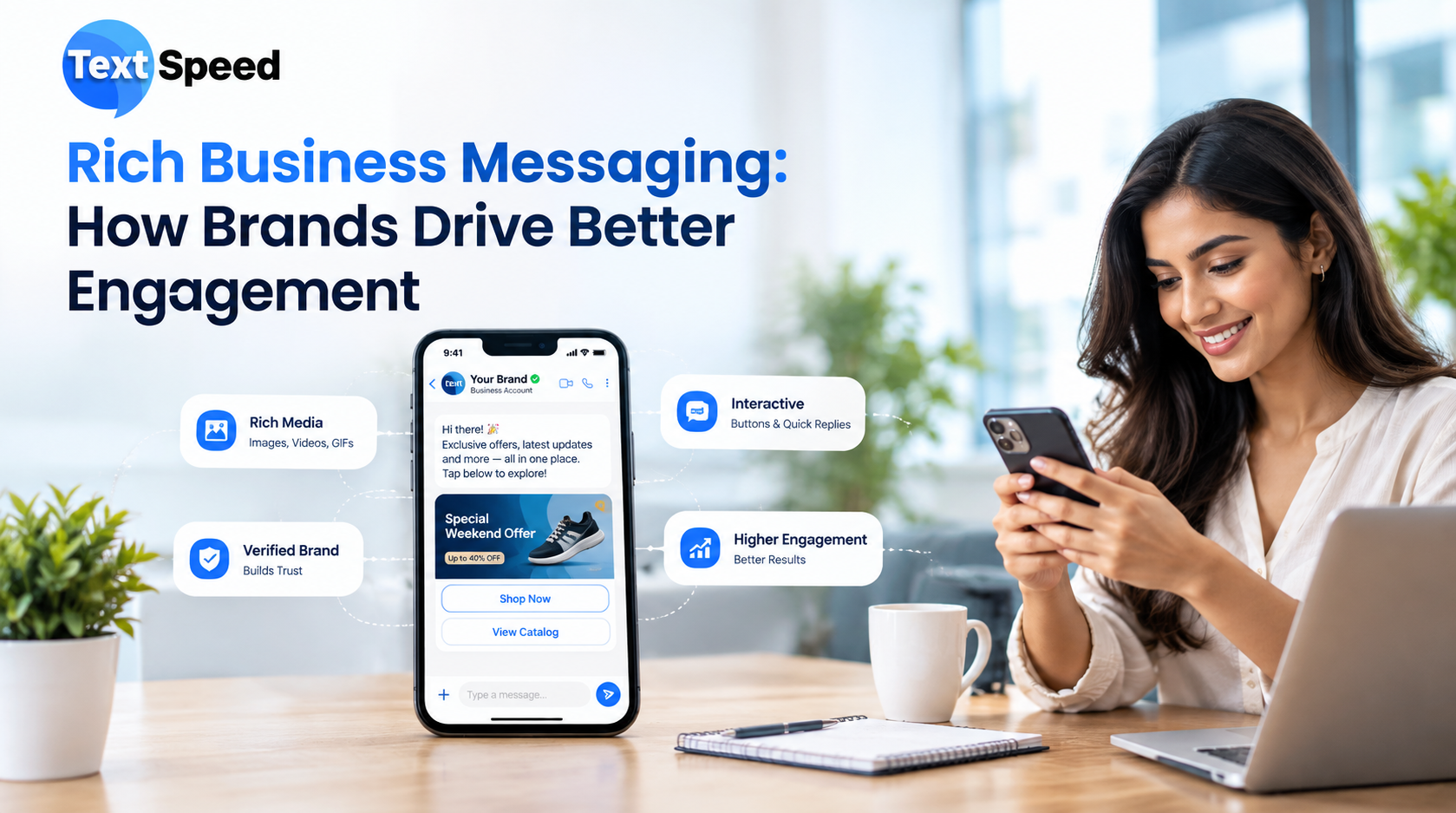
Traditional business messages are often limited to simple text. Rich business messaging adds more interactive elements to the conversation, allowing businesses to communicate information in a more engaging format.
Depending on the messaging platform and available features, brands can use elements such as:
- Images and videos
- Product information
- Rich cards
- Suggested replies
- Action buttons
- Website links
- Location information
- Offers and promotions
- Interactive menus
Instead of asking customers to remember a website address or search for information themselves, businesses can place relevant options directly inside the conversation.
Why Are Brands Moving Beyond Plain Text?
Imagine receiving a message from a retailer announcing a new collection. A plain SMS might contain a short description and a link.
A richer message could show a product image, brief details, price information, and a button leading directly to the product page.
The second approach gives the customer more context before they decide what to do.
This is one of the main reasons brands are exploring rich business messaging as part of their customer communication strategies.
How Rich Messaging Can Improve Customer Engagement
1. Makes Messages More Visual
Images, cards, and other media can help businesses explain products and services more effectively than text alone.
For example, a travel company can present a holiday package with an image, destination details, and a booking action.
2. Gives Customers Clear Actions
Interactive buttons can reduce the number of steps required to complete an action.
Depending on the platform, customers may be able to:
- View a product
- Visit a website
- Call a business
- Confirm an appointment
- Track an order
- Find a location
The easier the next step is to understand, the less effort customers need to make.
3. Creates More Useful Conversations
Business communication does not always need to be a one-way announcement.
Rich messaging can support conversations where customers select options, request information, or move between different stages of a service journey.
For example:
Customer: I want to check my order.
Business: Select an option.
[Track Order] [Contact Support] [View Products]
This creates a more structured customer experience.
Rich Business Messaging Use Cases
E-Commerce
Online retailers can showcase products, share offers, provide order information, and direct customers to relevant product pages.
Banking and Financial Services
Financial businesses can use suitable messaging workflows for notifications, service information, and customer interactions, subject to applicable regulatory and security requirements.
Healthcare
Healthcare organizations can use appropriate messaging for appointment-related communication, reminders, and service information while following privacy requirements.
Travel and Hospitality
Hotels, airlines, and travel businesses can provide booking information, destination details, reminders, and links to relevant services.
Real Estate
Real estate companies can share property information, images, project details, enquiry options, and site-visit actions.
Education
Educational institutions can use rich messages for course information, event invitations, registration links, and student communication.
Personalization Makes Rich Messaging More Relevant
More features do not automatically create better communication. Relevance is equally important.
A business could segment customers based on factors such as previous interactions, interests, location, or customer journey stage, where appropriate and permitted.
For example, an online retailer could show relevant products to customers who have expressed interest in a particular category rather than sending the same message to everyone.
Personalization should be used responsibly and should respect customer preferences and applicable privacy requirements.
Rich Messaging and Customer Journeys
One useful way to plan rich business messaging is to map it to the customer journey.
Awareness: Introduce a product or service.
Consideration: Provide useful information, images, comparisons, or FAQs.
Conversion: Add a clear action such as booking, purchasing, or registering.
Post-purchase: Share confirmations, updates, or support options.
Retention: Provide relevant updates and customer engagement opportunities.
This approach prevents businesses from treating rich messaging as just another promotional channel.
What Businesses Should Consider
Before implementing rich messaging, businesses should evaluate:
- Supported messaging channels
- Customer audience
- Integration requirements
- API capabilities
- Content formats
- Automation options
- Analytics
- Consent and communication preferences
- Regulatory requirements
- Human support availability
The technology should support the customer journey rather than make the conversation unnecessarily complicated.
Measuring Rich Messaging Performance
Businesses should monitor how customers interact with their messages.
Depending on the platform, useful metrics can include:
- Delivery rate
- Message interactions
- Button clicks
- Link clicks
- Conversion activity
- Customer responses
- Drop-off points
Comparing these metrics across different campaigns can help businesses understand which content and conversation flows are more useful to their audience.
Conclusion
Rich business messaging gives brands a way to make customer communication more visual, interactive, and action-oriented. Instead of relying entirely on plain text and external links, businesses can bring useful content and actions directly into supported messaging experiences.
From e-commerce and real estate to healthcare, education, travel, and financial services, the approach can be adapted to different customer journeys.
The key is not to add interactive features simply because they are available. Brands should use rich content where it makes communication clearer, reduces customer effort, or provides a more convenient next step. When combined with relevant content, thoughtful automation, and responsible customer data practices, rich messaging can become a valuable part of a modern communication strategy.
FAQs
1. What is rich business messaging?
It is a business communication format that can combine text with media, buttons, cards, links, and other interactive elements.
2. How is it different from regular SMS?
Regular SMS is primarily text-based, while rich messaging can provide additional visual and interactive features where supported.
3. Which businesses can use rich messaging?
E-commerce, healthcare, education, real estate, travel, finance, retail, and many other industries can use it for suitable customer communication.
4. Can rich messaging support automation?
Yes. Businesses can connect messaging platforms with APIs, chatbots, CRM systems, and automated workflows where supported.
5. How can businesses measure engagement?
Depending on the platform, businesses can track delivery, clicks, interactions, responses, and conversions.
Written by SEO Specialist
Telecom & CPaaS Technical Specialists · Reviewed for AccuracyOur content is authored by enterprise communications specialists and strictly reviewed for technical accuracy, regulatory compliance (TRAI/DLT), and industry best practices. Read our Editorial Policy to learn how we maintain trust.