
Introduction
Rich Communication Services (RCS) has changed the traditional messaging experience by adding features such as rich media, interactive buttons, branded content, and suggested actions. However, RCS availability can depend on factors such as the recipient's device, network, messaging application, or service availability.
This is where RCS fallback becomes important.
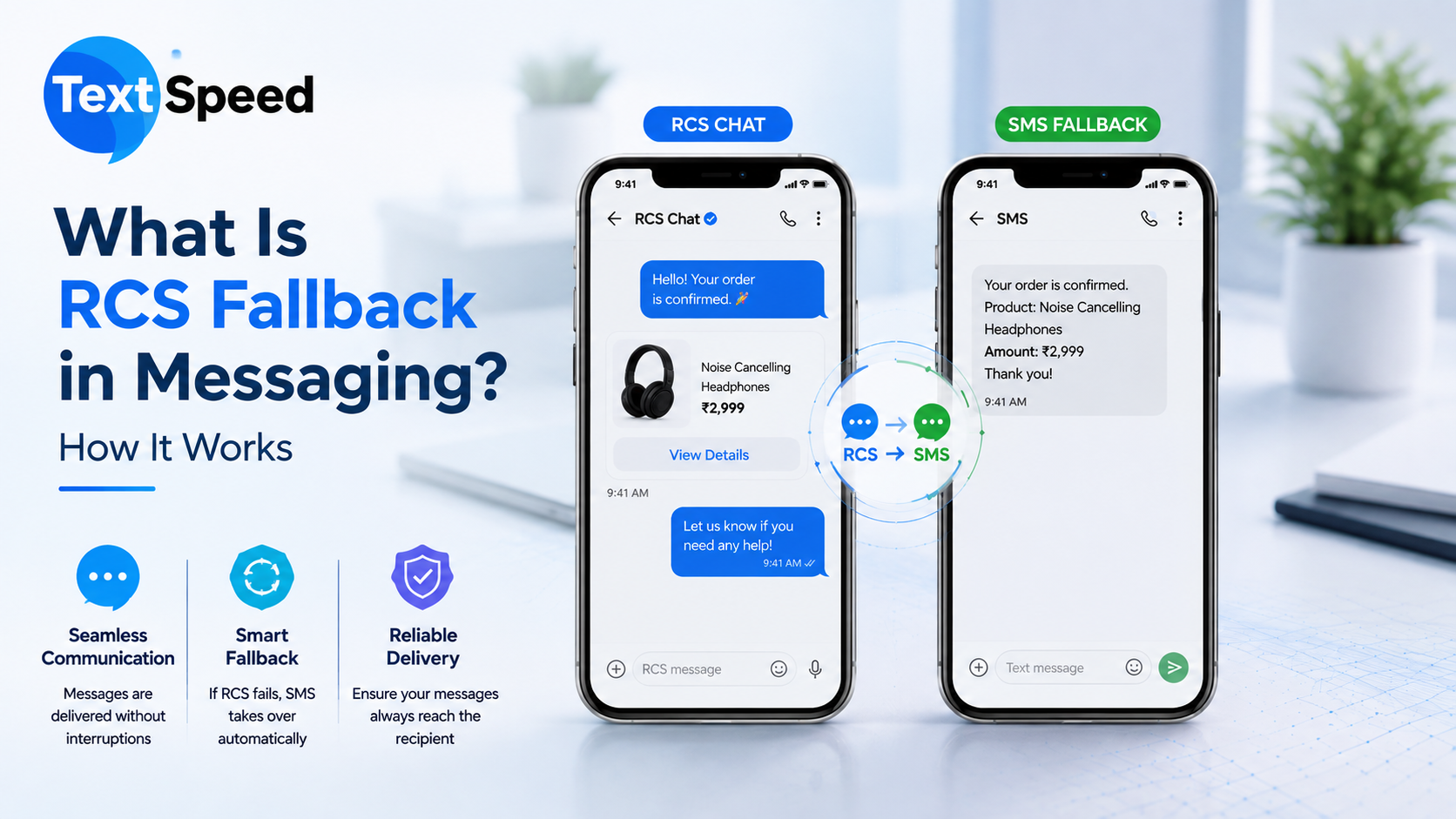
If you are wondering what is RCS fallback in messaging, it is a mechanism that allows a message to use another supported messaging channel when an RCS message cannot be delivered. In many business messaging implementations, SMS can serve as the fallback channel.
The objective is simple: keep the communication moving even when the preferred RCS experience is unavailable.
Why Is RCS Fallback Needed?
Businesses cannot assume that every customer will have access to RCS at the exact time a message is sent.
For example, a customer may:
- Use a device without RCS support
- Have RCS temporarily unavailable
- Lack a suitable data connection
- Be outside the supported RCS environment
- Experience a temporary messaging service issue
Without a fallback option, an important business message could fail to reach the customer.
For businesses sending time-sensitive information, this can create a poor customer experience.
How Does RCS Fallback Work?
The process is relatively straightforward.
Step 1: Business Creates an RCS Message
A business prepares a rich message containing text, images, buttons, links, or other supported content.
Step 2: System Checks RCS Availability
Before delivery, the messaging platform determines whether the recipient can receive the RCS communication.
Step 3: RCS Message Is Delivered
If RCS is available, the customer receives the richer messaging experience.
Step 4: Fallback Is Triggered
If RCS cannot be delivered under the configured conditions, the system can switch to an alternative channel, such as SMS, depending on the provider and implementation.
This process happens without requiring the business to manually resend every failed message
Why Businesses Use RCS Fallback
Understanding what is RCS fallback in messaging is particularly important for businesses that send critical or time-sensitive communication.
Better Delivery Continuity
Fallback provides another route for reaching customers when RCS delivery is not possible.
Reduced Message Failure
Instead of allowing an RCS message to simply fail, a configured fallback strategy can help deliver the essential information through another channel.
Wider Customer Reach
Businesses can use RCS where supported while still maintaining communication with customers who cannot receive RCS.
Better Customer Experience
Customers are more likely to receive important notifications without needing to understand the technical reason behind a failed RCS delivery.
Common Business Use Cases
RCS fallback can be useful across several industries.
E-Commerce
Businesses can send order confirmations, shipping updates, and delivery notifications through RCS, with fallback available when necessary.
Banking and Financial Services
Important account notifications and service alerts may require dependable delivery.
Healthcare
Appointment confirmations and reminders can benefit from a messaging strategy that prioritizes reliable communication.
Travel
Booking updates, schedule changes, and travel notifications can be time-sensitive and benefit from delivery continuity.
Retail
Promotional and customer engagement messages can use rich RCS features while maintaining an alternative communication route where appropriate.
What Happens to Rich RCS Features During Fallback?
One important point is that fallback does not necessarily preserve every RCS feature.
RCS can support interactive elements such as buttons, rich cards, and multimedia. If the message falls back to SMS, these advanced elements may not be available in the same format.
Therefore, businesses should design fallback content separately.
For example, an RCS message might contain a product image and “Buy Now” button, while its SMS fallback could contain concise text and a mobile-friendly URL.
This ensures the essential information remains understandable even without the rich RCS experience.
Best Practices for RCS Fallback
A good fallback strategy should focus on the most important information.
Businesses should:
- Keep fallback messages concise.
- Include the essential information.
- Use relevant and mobile-friendly links.
- Maintain consistent branding where possible.
- Test both RCS and fallback versions.
- Monitor delivery and engagement metrics.
- Follow applicable messaging regulations.
The fallback message should not simply be a shortened copy of the RCS message. It should be designed specifically for the alternative channel.
Is RCS Fallback Important for Businesses?
For businesses using RCS at scale, fallback can be an important part of a broader messaging strategy.
Instead of choosing between RCS and SMS, companies can use both strategically. RCS provides richer interactions when available, while fallback helps maintain communication when RCS delivery is not possible.
This approach allows businesses to balance engagement and reach rather than depending entirely on one messaging technology.
Final Thoughts
If you are researching what is RCS fallback in messaging, the simplest explanation is that it provides an alternative delivery route when an RCS message cannot reach the intended recipient.
RCS can deliver a richer and more interactive customer experience, but availability is not always universal. A properly planned fallback strategy helps businesses maintain communication continuity while using RCS to create more engaging conversations.
For companies managing notifications, customer support, marketing, or transactional messaging, combining RCS with an appropriate fallback channel can create a more dependable communication strategy.
FAQs
1. What is RCS fallback in messaging?
It is a mechanism that uses an alternative messaging channel when an RCS message cannot be delivered.
2. Is SMS commonly used as an RCS fallback?
Yes. Depending on the provider and implementation, SMS can be used as a fallback channel.
3. Does fallback preserve RCS buttons and rich media?
Not necessarily. Features available in RCS may not be supported by the fallback channel.
4. Why do businesses need RCS fallback?
It helps maintain communication reach when RCS is unavailable for a particular customer or delivery situation.
5. Can businesses customize the fallback message?
Yes. Businesses should ideally create a concise fallback version designed specifically for the alternative messaging channel.
Written by SEO Specialist
Telecom & CPaaS Technical Specialists · Reviewed for AccuracyOur content is authored by enterprise communications specialists and strictly reviewed for technical accuracy, regulatory compliance (TRAI/DLT), and industry best practices. Read our Editorial Policy to learn how we maintain trust.